Diesel Engine
Engineering Service Bulletin | Bulletin No: 001/ZOA/ESB-DBE/XI/2025
A diesel engine is a type of internal combustion engine that transforms the chemical energy in fuel into mechanical power through compression ignition. Named after its inventor, Rudolf Diesel, it is widely used in heavy machinery, trucks, ships, and backup generators because of its high torque and efficiency.
Diesel engine widely used at bulk carrier of merchant ship. It is designed to transport bulk cargo (such as grain, coal, ore, steel coils, cement, etc) in its cargo holds. Bulk carriers usually use two-stroke diesel engines (usually directly drive to the propeller) because they are cost-effective, durable, and fuel efficient. Two-stroke engines have a high power-to-weight ratio, which means ships can carry more cargo with the same amount of power. They also have better thermal and engine efficiency than four-stroke engines, and can burn low-grade fuel oil (heavy or marine fuel oil), whereas diesel engines generally use diesel fuel (HSD, bio-fuel).
Diesel en gines are also used to generate electricity in locomotives and power plants. In power plants, diesel engines can be easily restarted during power outages (compared to coal-fired power plants and gas turbine power plants). In addition to being used to power trucks on highways, diesel engines are also used in mining areas and off-highway as engines for haul trucks, excavators, and other vehicles. In these industry, diesel engines typically operate on a 4-stroke engine.
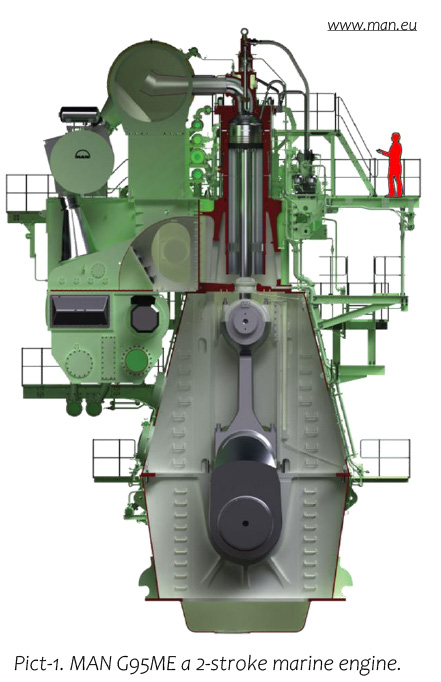
The 1st picture is MAN G95ME-C, example a marine diesel engine with 3,460 mm piston stroke, 950 mm piston bore/diameter and 12 cylinder can deliver power 82,440 kW at 102 RPM. Another largest marine engine is Wärtsilä RT-flex96C. The Wärtsilä RT-flex96C is a two-stroke turbocharged low-speed diesel engine (speed is 120 RPM). The 14-cylinder version with 2,500 mm piston stroke and 960 mm piston bore and produces 80,080 kW.
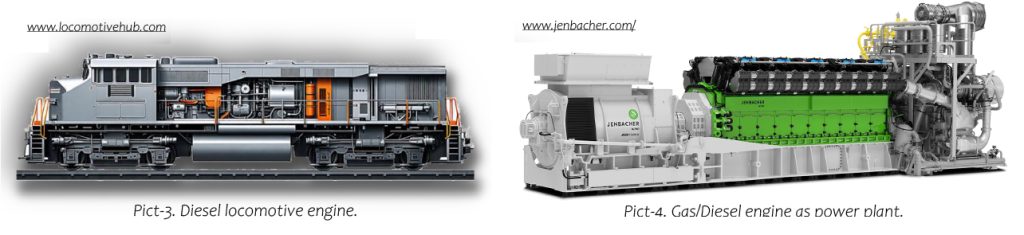
The 2nd picture is Caterpillar 798AC, a off-highway haul truck. The prime mover is single engine Cat® C175 16 cylinder can produce 2,610 kW with nominal payload up to 371 ton.
Diesel Engine Cycle
To measure the performance of a diesel engine, we need to understand how it works. According to Wikipedia, a diesel engine, also known as a diesel engine (or compression-ignition engine), is an internal combustion engine that uses hot, compressed air to ignite and burn fuel injected into the combustion chamber. These engines do not use spark plugs like gasoline or gas engines. Internal mixture formation. In diesel engines, the mixture of air and fuel is only formed inside the combustion chamber.
Diesel or gas engines are mainly divided based on the number of piston strokes and crankshaft revolutions required to complete one complete combustion cycle, namely 2-stroke and 4-stroke. Below is a simple schematic of a 2-stroke diesel/gas engine.
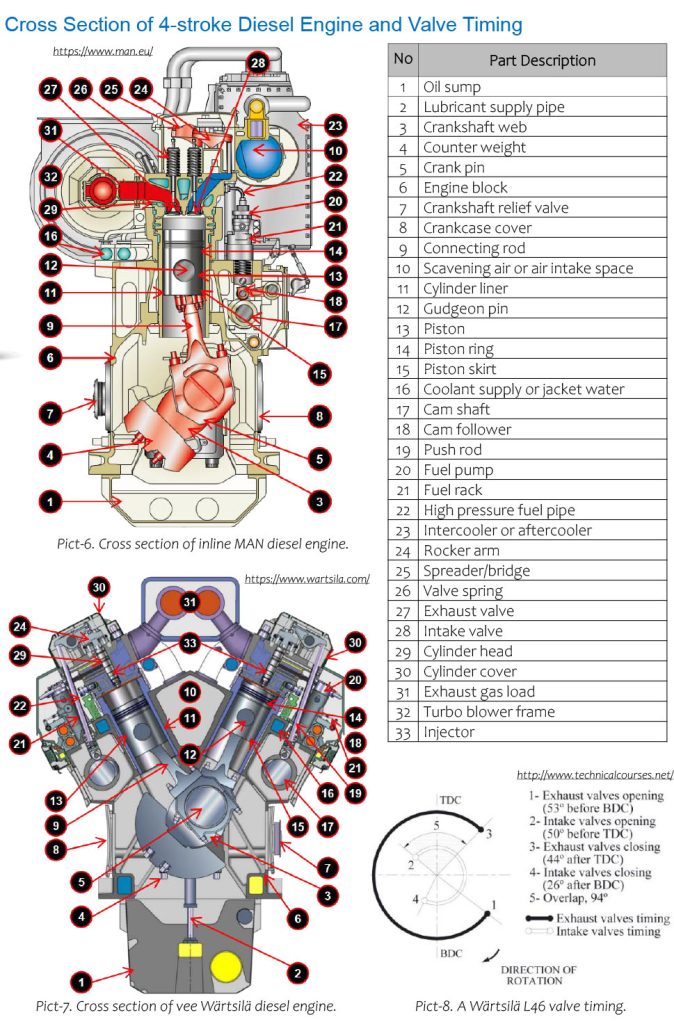
In a 2-stroke diesel engine 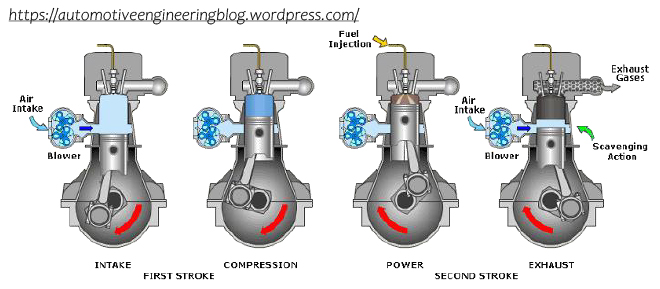 or other internal combustion engine, to produce a work it takes 4 strokes (scavenging – compression – work – exhaust) in one cycle (360 degree). In a 4-stroke, to produce a work it takes 4 strokes (scavenging – compression – work – exhaust) in two cycle (720 degree). The scavenging or intake air is compressed as the piston moves upwards and diesel fuel is injected into the combustion chamber just before the piston reaches top dead center (TDC).As explained on the previous page that 2-stroke in an internal combustion engine is that to perform one power stroke requires one crankshaft rotation (one upstroke and one downstroke). Meanwhile, a 4-stroke diesel/gas internal combustion engine is an engine that requires two crankshaft rotations (two upstrokes and two downstrokes) to perform one power stroke (see timing valve below).
Measure the Engine Performance
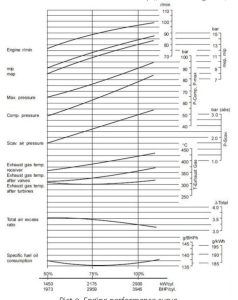
When diesel engine is manufactured (especially large-capacity engines), the manufacturer will conduct a shop test and then a commissioning test under real-world conditions (commissioning tests in the shipping industry are commonly known as sea trial). This ensures that the engine has an ideal baseline condition or performance based on shop test and commissioning test data. This ideal condition data will be used by the Maintenance Team as a reference when routine maintenance is performed or repairs are made in the event of damage, bringing the engine’s performance and condition closer to its initial commissioning condition.
The following image is an example of a performance curve for a diesel engine during a commissioning test, engine test bed or sea trial.
The data for the performance curve above is taken from calibrated indicators that installed on the engine (such as pyrometers, thermocouples, temperature gauges, pressure gauges, flow meters, sounding levels, power meter, other transmitter etc.). The engine’s health (such as determining whether the engine is fit for safe and efficient operation, etc.) depends on the condition and accuracy of the installed indicator readings.
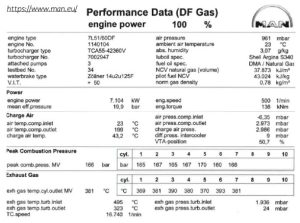
The image on the left is another example of performance data from a MAN 7L51/60DF dual-fuel engine during shop test or test bed by the manufacturer. Each parameter reading will provides accurate information when the indicator is functioning properly and calibrated. This allows for easy analysis, conclusions, and even recommendations based on accurate parameter data if anomalies occur during routine performance monitoring or data collected by operator when daily activities.
Other data is needed to determine the thermodynamic and mechanical conditions when the unit is operating in addition to utilizing indicators that have been installed on the machine to measure diesel engine performance. One example of a tool used to perform these measurements is the Haliza Machinery Analyzer which is equipped with a rotation sensor (reading crankshaft rotation), a pressure sensor (reading combustion pressure in the combustion chamber), a vibration sensor (reading mechanical vibrations that occur in the cylinder head or main bearing), a secondary ignition sensor (reading the size of the spark jump from the coil to the spark plug for gas engines) and an analog input (reading combustion pressure data from existing sensors installed in new diesel engines). Haliza machinery analyzer as a measuring tool to take data to the field with various combinations of available sensors and supported by SofHaliza as a database management and analysis software.
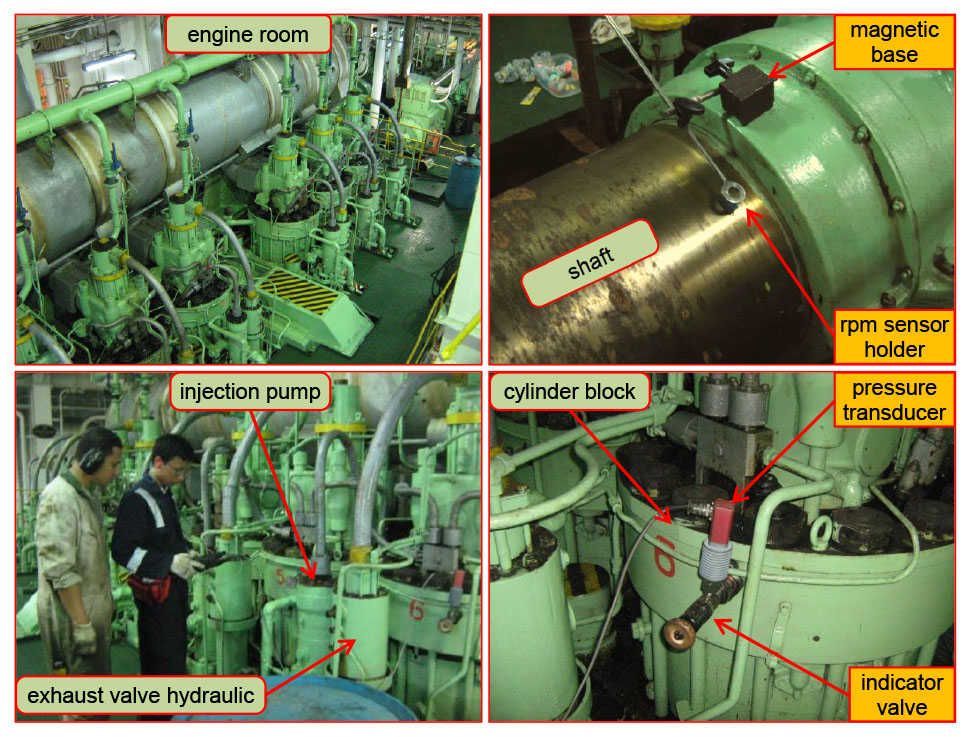
The next pictures are an activity when conduct engine performance measurement using Haliza machinery analyzer on a coal vessel. The main engine is a single Hitachi B&W 6L67GB, 2-stroke, 6-cylinder single acting, double turbocharger VTR-454, MFO and 114 RPM maximum speed with BHP 14,000 PS direct couple to the propeller shaft.
To measure the combustion (compression) pressure, we used pressure transducer that connected to indicator valve (indicator cock) was installed in every cylinder block, using magnetic pick-up to record every cycle of crankshaft rotation, using accelerometer as vibration sensor to measure mechanical condition on the cylinder block and engine frame. All these sensor was recorded using Haliza and then will be analyze using SofHaliza.
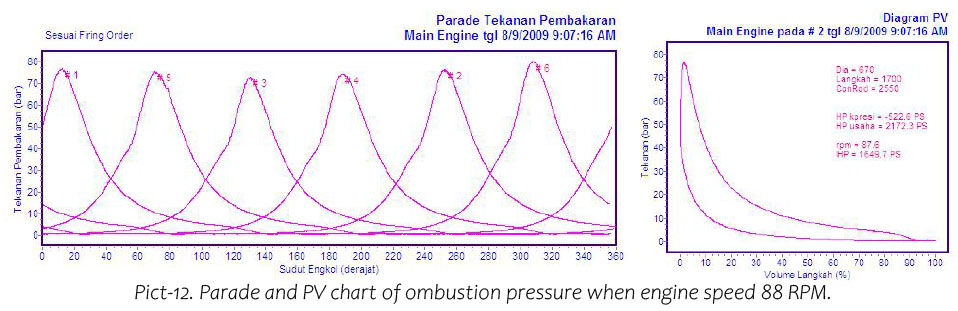
The image below is an example of a marine diesel engine’s combustion pressure data. The data shows that the pressure across all cylinders is balanced (uniform), with an indicated horsepower calculation for one cylinder of 1,649 PS (or 9,894 PS for all 6 cylinders if the power output is assumed to be the same for all cylinders) at 88 RPM.
Next images are other example of performance data from two diesel generators. One cylinder in each unit has the lowest combustion pressure compared to the other cylinders. This condition is caused by different factors and requires different repair recommendations.
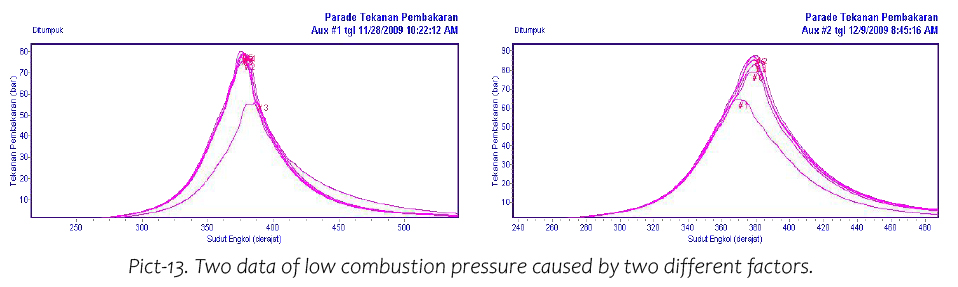
Thermodynamic data (and vibration data) from combustion pressure can provide further information about what’s happening in the combustion chamber, such as when fuel is injected into the combustion chamber, how it atomizes, how long the mixture delay is, when the fuel starts to burn, and so on. The combination of thermodynamic data analysis and information from local indicators will provide precise recommendations to maintain engine reliability and efficiency.
How to Measure Performance on High-Speed Engines?
How do you monitor a diesel or gas engine that doesn’t have an indicator valve or is operating at high speed revs? Diesel or gas engines are further divided into three categories by speed: low-speed, medium-speed, and high-speed.
Low-speed are considered to be up to 300 rpm, such as most large two-stroke engines commonly found on ships as main engine. Usually an indicator valve is installed. For new or modern engines, peak pressure and other sensors (temperature, pressure, flow etc) is usually permanently installed and continuous recording.
Medium-speed range from 300 to 900 rpm. These engines are most commonly used in small boats and power plants, prime mover of electric generators and/or propellers. Usually an indicator valve is installed. For new or modern engines, peak pressure and other sensors (temperature, pressure, flow, knocking etc) is usually permanently installed and continuous recording.
High-speed are the most common. Their high revs are ideal for powering vehicles such as buses and yachts. All trucks and diesel vehicles on our roads use this class of diesel, with revs above 900 rpm. For new or modern engines, other sensors (temperature, pressure, flow, knocking etc) is usually permanently installed.
Some diesel or gas engines operating at speeds above 1,000 rpm, or newer engines, are not equipped with an indicator valve to monitor combustion conditions in the combustion chamber. However, some newer diesel engines are equipped with a peak pressure sensor (combustion pressure data is recorded in a log sheet, as shown in Pict-10).
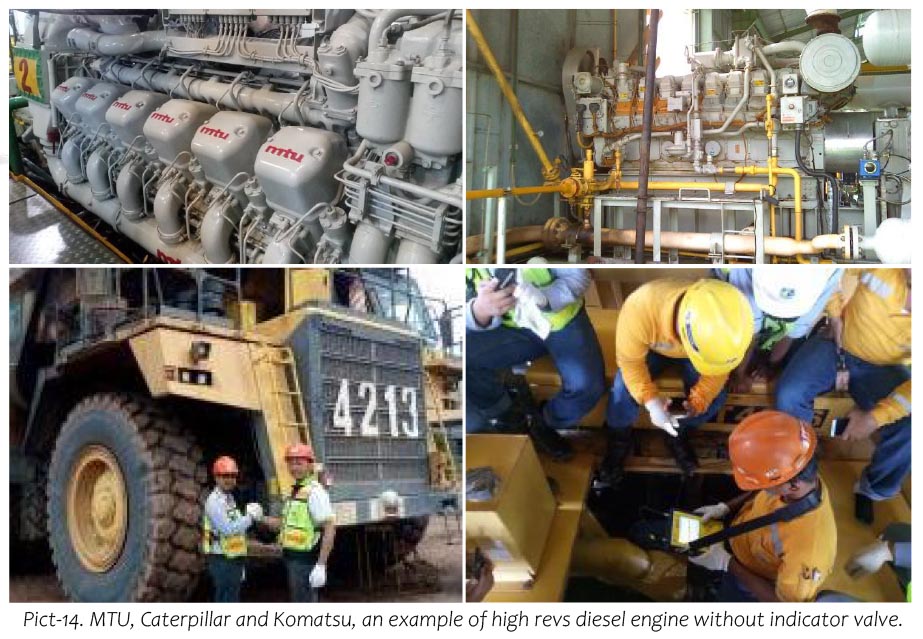
Here is an example of a high-revving diesel or gas engine that does not have an indicator valve installed to determine combustion pressure condition:
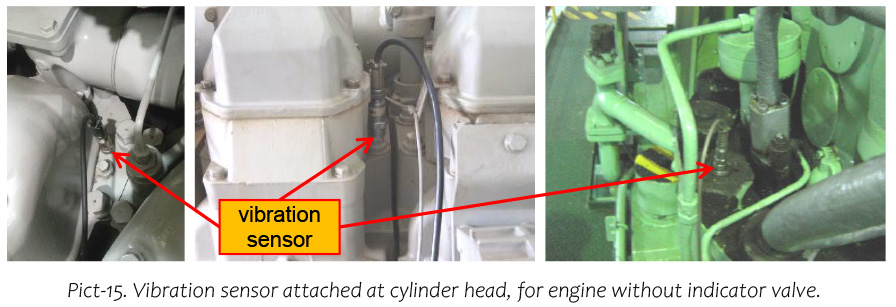
If the engine isn’t equipped with an indicator valve, performance measurements can be performed using a vibration sensor and operating parameter analysis. The vibration sensor detects any vibrations generated by the engine, whether due to combustion or mechanical conditions. The following is an example of vibration data collection to determine the mechanical and combustion vibrations in each cylinder.
Reciprocating Vibration Analysis and Mechanical Findings
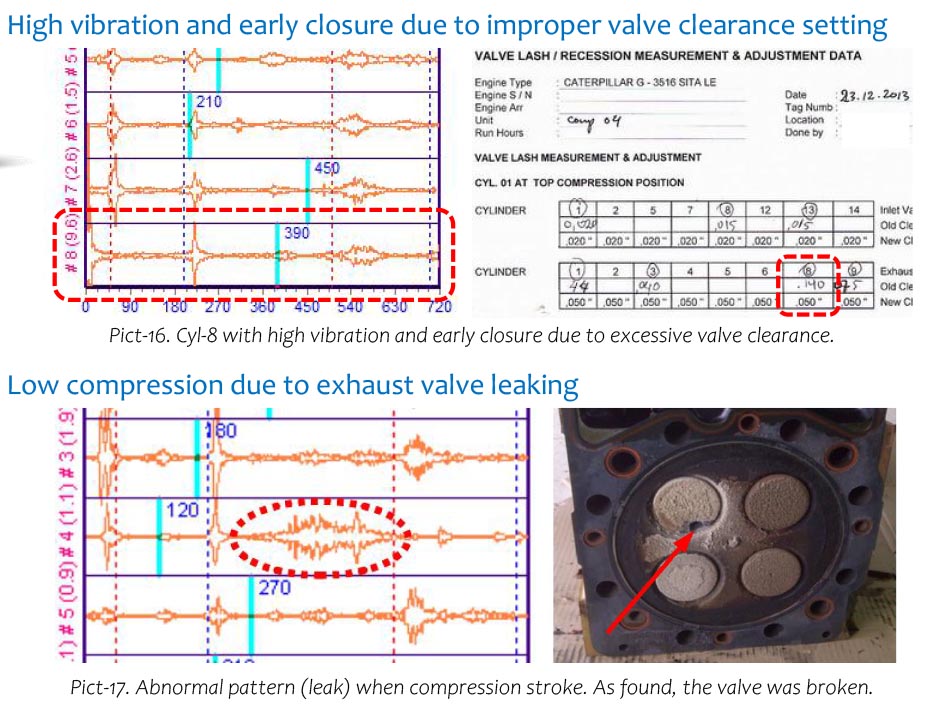
Cylinder head vibration data will describe the mechanical vibrations generated when the valve impacts the valve seat or other valve train events (push rod, rocker arm, etc.) based on the engine type (2-stroke or 4-stroke). If there is a vibration anomaly, a different vibration pattern will be seen (high vibration, early or late closure, etc.). The specific purpose of this activity is to monitor the impact level. If we can maintain the impact level as optimal as possible, we will reduce excessive mechanical stress on the cylinder head and valve train. Thus, the components in the cylinder head will be more durable and reliable.
Here are some examples of cylinder head vibration analysis on high revs diesel or gas engines that are not equipped with an indicator valve.
Conclusion
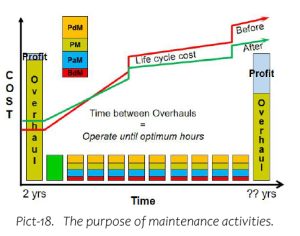
With routine measurement, analysis from various data sources (reciprocating analysis data, machine local indicator or parameters, maintenance history, manuals, etc.) combined with great maintenance strategy (BdM, PM, PdM and PaM), the maintenance activity and corrective actions to maintain engine performance will be more focused to the problems and measurable which can reduce breakdown, improve reliability, reduce emision and save maintenance costs.